
Borehole Steel Pipes: Slotted and Plain Casing for Water Boreholes
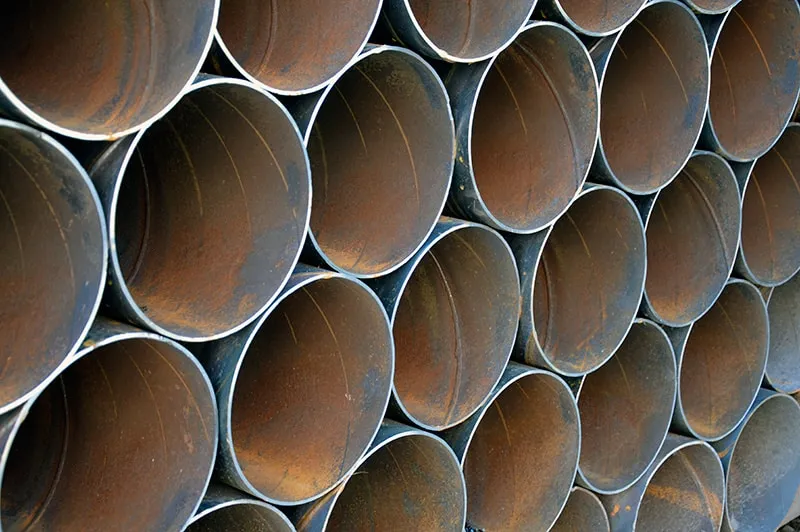
Borehole steel pipes are the steel casing that lines a water borehole from the surface down to the aquifer: plain pipe where the hole has to be sealed and held open, and slotted pipe where the water has to come in. At Juma Metal we have been manufacturing and supplying slotted steel pipe for water boreholes since 1965, from our own plant in La Villa de Don Fadrique (Toledo, Spain). We keep stock in diameters from 120 to 320 millimetres, in 6-metre lengths, and we supply projects in Spain and abroad.
This page explains what the casing does, when steel is the right material and when PVC is enough, what the slots can and cannot do, and what data we need from you or your driller to quote a borehole. It is written for the people who actually order the pipe: farmers, livestock breeders, drilling contractors, installers and distributors.
What a borehole is and why it needs casing
A borehole is a narrow hole drilled into the ground until it reaches the water table, so that the water can be pumped up with a submersible pump and sent through pipes or channels to where it is used. The casing keeps the walls of that hole from collapsing, stops loose ground from filling it, and lets water from the aquifer flow into the borehole through the slotted section.
Groundwater already carries a large part of the world’s supply. According to the United Nations World Water Development Report 2022, groundwater already supplies half of the water withdrawn for domestic use worldwide and around 25 % of the water withdrawn for irrigation, and agriculture accounts for 69 % of all groundwater abstractions [1]. In Spain, where we work, the Ministry for the Ecological Transition counts slightly more than a thousand aquifers outside the Canary Islands, covering almost half of the country, and links almost 70 % of water demand to irrigation [2].
A water catchment project is more than digging until water appears. Drilling changes the balance of the aquifer, and a badly built borehole can dry out or pollute the water table and affect the ecosystems above it. So the work needs trained drillers, precise machinery and care for the surroundings, and the pipe that lines the hole is not an accessory. The Rural Water Supply Network’s Code of Practice for Cost-Effective Boreholes states that boreholes are drilled to work for 20 to 50 years [3]. The casing has to last that long too.
Borehole or open well: the differences
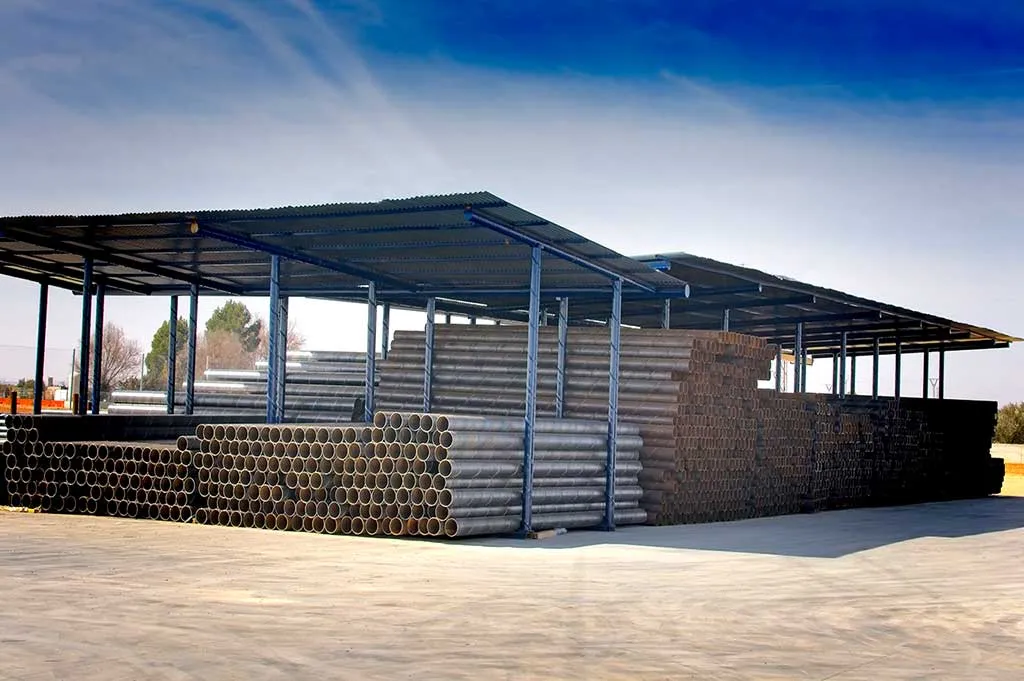
Both reach groundwater. The technique changes the depth you can reach, the pipe you need and the space the work takes up on your land.
| Feature | Borehole | Open well |
|---|---|---|
| Usual diameter | Around 180 mm | Over 1 metre |
| Depth | Up to several hundred metres | Rarely more than 12 metres |
| Lining | Always cased: plain pipe plus slotted pipe at the aquifer | Not always lined |
| Water extraction | Submersible motor pump and rising pipe | Pump or direct lifting |
| Space on the surface | Very small | Considerable |
Reference values from our experience manufacturing and supplying borehole pipe, not a statistic. Each site and project will differ.
The borehole is the only one of the two that reaches water lying deep underground, and that is where its advantages come from:
- Lower water bills. Your own supply cuts what you pay for water, especially when it goes to irrigation.
- Access to deep groundwater. A borehole reaches water bodies that a dug well cannot.
- Little space used. The wellhead takes up a very small area of the plot.
- Competitive cost per metre. In our experience a metre of borehole usually costs less than a metre of other types of well.
Speed of execution, cost and results are why the borehole is the option we are asked about most often when a farm needs to pump groundwater.
Borehole steel pipes or PVC casing
PVC is cheaper to buy, light and does not rust, which is why it is common in shallow or domestic boreholes. Steel wins when the borehole has to cope with depth, unstable or fractured ground, or decades of service without anyone pulling the casing out. It takes the side pressure of the ground and the rubbing against the hole walls while the string is lowered, and it does not crack if the column takes a knock during installation.
| Question on your project | Points to steel | Points to PVC |
|---|---|---|
| How deep is the borehole? | Deep holes, where the column hangs a lot of weight | Shallow holes |
| What is the ground like? | Unstable, fractured or caving formations | Stable formations |
| How is the casing installed? | Heavy rigs, long strings, rough handling on site | Careful handling, short strings |
| Is the water aggressive? | Neutral water, or steel with a protective finish | Acidic or highly mineralised water |
| What drives the decision? | Service life with no intervention | Lowest initial outlay |
Both materials can also go in the same borehole, for example steel in the upper, unstable part of the hole and a lighter material further down; that is a decision for whoever designs the column. What makes no sense is to save on the casing of a borehole designed to work for decades. Pulling out and replacing a pipe that has given way, tens of metres down, costs far more than the price difference at the start.
Slotted steel pipe: what the slots really do
To get the most out of a borehole, the casing has to let water through where the aquifer is. That is the job of slotted pipe: steel pipe with grooves or holes along its length, placed facing the water-bearing layers, with plain pipe above and below.
The slots have a limit that is worth knowing before designing the column. Writing in the Water Well Journal of the National Ground Water Association, hydrogeologist Thom Hanna notes that the open area of mill-slot screens is typically less than 4 %, while continuous-slot wire screens can exceed 30 % [4]. He also explains that water flows more freely through a higher open area, because entrance velocity and head loss drop [4].
What this means when you order slotted pipe: the flow the borehole can deliver depends on how much slotted pipe faces the aquifer, not only on the pipe diameter. If the expected yield is high, plan enough slotted length at the water-bearing layers, and give your driller’s log to whoever designs the column.The space between the pipe and the hole wall matters too. The drilled diameter has to be larger than the casing, so there is an annular gap around the pipe. Along the slotted section that gap is usually filled with filter gravel, and in the top metres it is sealed with cement to keep surface water out of the borehole.
Corrosion: check the water before choosing the steel
Steel lasts decades underground when the water allows it. When it does not, corrosion thins the wall and the minerals it releases can clog the slots. This is not a rare case: a national assessment of more than 20,000 wells by the U.S. Geological Survey found that 25 US states have groundwater with high or very high potential to be corrosive [5].
So before closing the order, ask for a basic analysis of the water (pH, conductivity, hardness) if there is one from nearby boreholes, and tell us the result. It helps decide the wall thickness and whether a protective finish is worth paying for.
If a hot-dip galvanized finish is specified, the reference in Europe for galvanizing fabricated steel articles in batches is EN ISO 1461:2022 [6]. The minimum mean coating thickness it sets depends on the steel thickness: 85 µm for steel thicker than 6 mm and 70 µm for steel between 3 and 6 mm, according to the summary of the American Galvanizers Association [7]. If your project calls for a specific finish, tell us when you ask for a quote.
Drilling machinery and pipe diameter
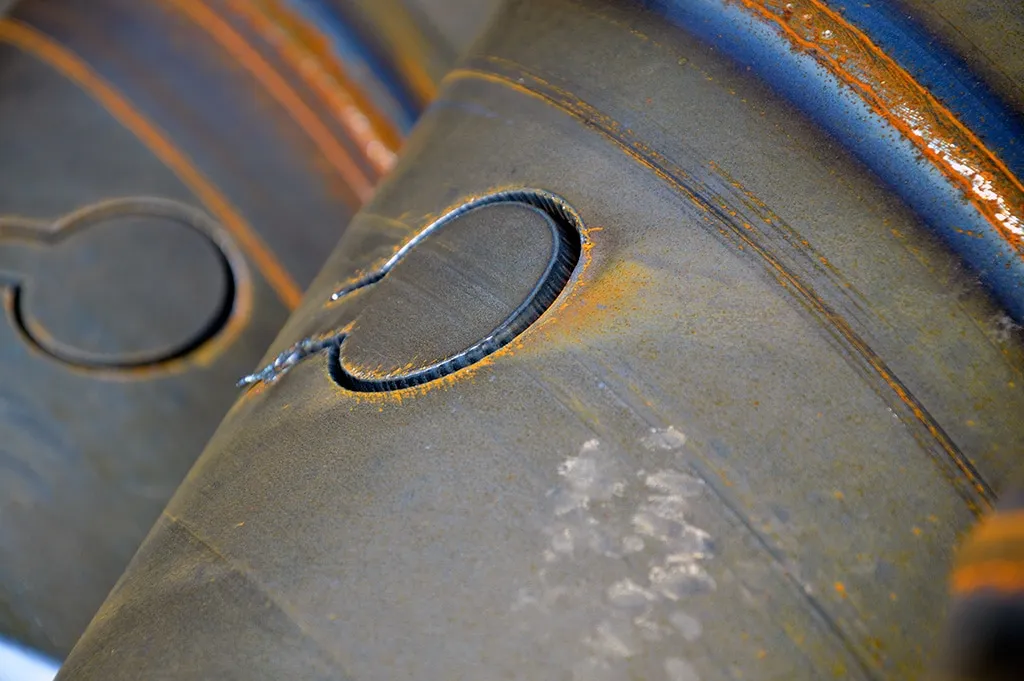
Because of their depth, boreholes are drilled with machines capable of going down to the bottom of the aquifer. There are two classic families and a hybrid of the two:
- Percussion rigs work in two stages: they hoist a heavy tool and let it fall freely to strike the ground, deepening the hole blow by blow.
- Rotary rigs use a motor that turns a cutting tool to advance through the ground continuously.
- Down-the-hole hammer rigs combine both: the tool rotates while a pneumatic hammer at the bottom of the hole strikes the rock. They are meant for hard ground.
The rig and the bit set the final diameter of the hole, and that sets the largest casing that will fit with its annular gap. The pipe supplier and the drilling contractor should therefore agree on the diameter before the rig reaches the site, not improvise it on site.
What we need to quote your borehole pipe
There is no single price per metre for borehole steel pipes: it changes with diameter, wall thickness, finish, how much of the column is slotted, the total length and the transport to site. With this information we can give you a real quote:
| Data | Why we ask for it |
|---|---|
| Drilled diameter | It sets the largest pipe that fits with room for gravel and grout. We make from 120 to 320 mm. |
| Planned depth | It sets the number of 6-metre lengths and joints, and the weight the column has to carry. |
| Depth of the water-bearing layers | It tells us where the slotted pipe goes and where the plain pipe goes. |
| Expected yield and pump | The pump has to fit inside the casing, and the yield decides how much slotted length is needed. |
| Water analysis, if available | It decides the wall thickness and whether a protective finish is worth it. |
| Delivery address and date | 6-metre pipe is not easy to move: distance and timing count in the quote. |
Farmers and livestock breeders usually start from the water they need for irrigation or troughs, and the diameter comes from there. Drillers and installers need the exact size closed with us before moving the rig. Distributors mostly ask about lead time and stock, because they resell against projects with a fixed date. We keep the usual sizes in stock so that a borehole project does not stop waiting for pipe.
If your farm is also planting or renewing a vineyard, we manufacture galvanized steel vine poles for trellising as well. You can see our full range on the products page and our history on the about us page.
Ask for a quote for your borehole
Tell us the drilled diameter and the planned depth, and we will tell you which pipe you need and when you can have it on site.
Request a quoteReferences
[1] UNESCO World Water Assessment Programme. (2022). The United Nations World Water Development Report 2022: Groundwater: Making the invisible visible. UNESCO. https://www.unesco.org/reports/wwdr/2022/en
[2] Ministerio para la Transición Ecológica y el Reto Demográfico. (n.d.). Regadío y medio ambiente. Gobierno de España. Retrieved September 24, 2026, from https://www.miteco.gob.es/es/agua/temas/gestion-sostenible-de-regadios/agua-agricultura-regadio/regadioymedioambiente.html
[3] Danert, K., Armstrong, T., Adekile, D., Duffau, B., Ouedraogo, I., & Kwei, C. (2010). Code of practice for cost effective boreholes. Rural Water Supply Network. https://www.rural-water-supply.net/en/resources/128
[4] Hanna, T. (2023, December 27). Well screens. Water Well Journal. National Ground Water Association. https://waterwelljournal.com/well-screens/
[5] U.S. Geological Survey. (n.d.). Corrosivity. Retrieved September 24, 2026, from https://www.usgs.gov/mission-areas/water-resources/science/corrosivity
[6] European General Galvanizers Association. (n.d.). Standards. Retrieved September 24, 2026, from https://www.galvanizingeurope.org/galvanizing/standards/
[7] American Galvanizers Association. (n.d.). ISO 1461. Retrieved September 24, 2026, from https://galvanizeit.org/knowledgebase/article/iso-1461
Frequently asked questions
Which pipes are best for a borehole?
It depends on depth, ground and water. PVC is cheaper and works in shallow boreholes in stable ground. Steel is the safer choice for deep boreholes, unstable or fractured formations and projects meant to run for decades without pulling the casing, because it takes the ground pressure and rough handling during installation.
How much does borehole steel pipe cost?
There is no single price per metre. It depends on the diameter, the wall thickness, the finish, how much of the column is slotted, the total length and transport to site. Send us the drilled diameter, the planned depth and the depth of the water-bearing layers and we will quote the exact column.
What is the standard length of a borehole casing pipe?
Our borehole steel pipe comes in 6-metre lengths, in stock in diameters from 120 to 320 mm. The number of lengths and joints follows from the planned depth of the borehole.
What types of borehole casing pipe are there?
By material, mainly steel and PVC. By function, plain pipe, which lines and seals the hole, and slotted pipe or screen, which lets water in at the aquifer. Slotted steel pipe has less open area than continuous-slot wire screens, so the slotted length has to match the expected yield.
What is the difference between slotted and plain borehole pipe?
Plain pipe holds the hole open and seals it where there is no water or where surface water must be kept out. Slotted pipe has grooves along its length and is placed facing the water-bearing layers so water can flow into the borehole.
Does steel borehole casing rust?
Steel can corrode if the groundwater is acidic, highly mineralised or aggressive. A water analysis before ordering helps: it decides the wall thickness and whether a protective finish, such as hot-dip galvanizing, is worth it.
What is the difference between a borehole and a well?
A borehole is a narrow drilled hole, around 180 mm in diameter, that can reach several hundred metres deep and is always cased. An open well is usually over a metre wide and rarely deeper than 12 metres.